Liberty Defense Signs Canada’s Largest Airport to Test AI Security Detection System

Liberty Defense Holdings Ltd.a leading technology provider of threat detection solutions for concealed weapons, is pleased to announce that it has signed an agreement with The Greater Toronto Airports Authority (“GTAA”) to trial HEXWAVE™ at Toronto Pearson International Airport (“Toronto Pearson”) during the third quarter of 2022.

Toronto Pearson is located in Mississauga, west of Toronto, in Ontario, Canada. It is Canada’s largest airport, the sixth-most-connected airport in the world and the second-most-connected airport in North America.

Toronto Pearson will be the first airport in the world to trial the HEXWAVE walkthrough security detection portal. Several key members of the Liberty Defense team, including CEO Bill Frain, have previously been involved in the development and mass deployment of key screening technologies that are commonly found today at airports around the world.

“The HEXWAVE is planned to act as an additional layer of security at airports, extending the perimeter of the screened area to include the entrance to the airport itself,” said Bill Frain, CEO of Liberty Defense. “As airports continue to look at innovative ways to improve security, technology like HEXWAVE provides the ultimate solution.”

This strategy is known as a layered defense strategy, and it makes it possible for security teams to detect threats at the perimeter of a property without obstructing the movement of large groups of people. HEXWAVE can operate in both indoor and outdoor environments, providing additional flexibility for deployment of the system.

HEXWAVE uses 3D radar imaging and artificial intelligence, primarily to detect and identify concealed weapons, as well as other threats and anomalies, whether they are metallic or nonmetallic. The experience of passing through a HEXWAVE device is completely seamless. There is no need to stop and remove keys, cell phones, or other items from pockets. Moreover, HEXWAVE does not retain the 3D radar image and only displays a standardized person outline as shown in the figure included here.

“The GTAA places passenger and staff safety as our highest priority, and this means taking a proactive, innovative approach to staying ahead of emerging threats and minimizing them,” said Dwayne Macintosh, Director of Corporate Safety and Security for the GTAA. “We look forward to trialing HEXWAVE, and its potential to enhance safety at Toronto Pearson.”

As previously announced, Liberty is also working with the U.S. Transportation Security Administration (TSA) for demonstration and evaluation of the HEXWAVE and its expanded capabilities for screening aviation workers at a TSA designated airport location to enhance detection and throughput performance.

Detection, Threat

Basic Radiation Protection Technology book, now available for free

​After a continuous run of 39 years and 6 editions, the printed version of the Gollnick textbook Basic Radiation Protection Technology has gone “Out of Print” as of the beginning of 2022.

Printed copies are no longer available. However, in view of the continued interest in the material, the author, Daniel Gollnick, has made the text available to the general public, as an electronic “pdf file”, under a Creative Commons License, at no cost, i.e., FREE TO EVERYONE! Click here to go to the website to download

The text BASIC RADIATION PROTECTION TECHNOLOGY by Dr. Daniel Gollnick is designed to prepare you for the written examination given by the National Registry of Radiation Protection Technologists (NRRPT). 

Dr. Gollnick's materials were developed to meet the needs of both experienced technologists as well as people new to the field. Examples and applications are drawn from a variety of practical settings including reactors, hospitals, universities, nuclear accelerators, government labs and industry.

Impertech unveil new IM76 respirator at Shot Show 2022

The new IM76 respirator by Impertech has been designed to meet challenges and withstand extreme conditions like never before. With its patented panoramic visor, advanced multi feature interface platform and versatile filter attachments, the IM76 is the protection against CBRN threats you need for your fighters facing the future of defense.

Just some of the features include:

  • Filtering and respiratory protection from CBRN materials
  • Adjusted to fit with 6 harnessing straps.
  • Advanced and patented panoramic visor system
  • ballistic + anti-fog + anti-glare + anti-flash visors. Internal optical visors for eyeglasses users
  • Modular filter assembly according to your needs: front, left or right side.
  • Anthropometric: the mask effortlessly fits and seals all facial structures and genders
  • Light, easy to wear and carry
  • A voice membrane interface allows communication with team members
  • Communication system includes inner microphone unit and outgoing connector to communication devices
  • A drinking tube allows for safe refreshment without having to remove the mask
  • An exhaust system to drain fluids prevents body fluids from accumulating in the mask

To find out more about the IM76, head to the Impertech website today. 

CBRNe, Protection, Respirator

Avon Protection delivers 100,000th Mask to NSPA

In 2020, the NATO Support and Procurement Agency (NSPA) awarded Avon Protection a 10-year contract to supply a complete CBRN personal respirator system. The framework contract enables NATO countries and partners to purchase Avon Protection’s market leading respirator system, including the FM50, MP-PAPR, ST53, filters and related accessories.

Not only have Avon Protection recently completed their first successful year of delivery against the 10-year contract, but they have now reached a significant milestone with the delivery of the 100,000th FM50 across all NATO nations.

The FM50 is the most operationally proven and widely deployed battlefield respirator in the world. Many NATO countries and partners, including Belgium, Denmark, Finland, The Netherlands, Norway, Latvia, Lithuania and more recently Turkey, have already utilised the framework contract to equip their military personnel.

The FM50 respirator and a suite of filters are at the core of the personal respirator system selected by NSPA. Developed in conjunction with the United States Department of Defense to counter the multiple CBRN threats met in modern war fighting, anti-terrorist and peace-keeping operations, the FM50 is the most operationally proven and widely deployed battlefield respirator in the world.  

Commenting, Steve Elwell, Vice President Europe, Middle East and Asia at Avon Protection, said:

“This is a significant milestone for Avon Protection and demonstrates the ability of our business to supply product of the highest quality and performance to protect NATO’s troops for the forseeable future.”

CBRNe, Protection, Respirator

Experience FR 2022 is coming!

ExperienceFR 2022, the 10th Annual Exposition and Training Conference for today's warfighter and first responder, is coming to the MGM National Harbor in Oxon Hill, Maryland, on March 1-2, 2022. This event, organized by Federal Resources, a Noble company, is an exhibition of technologically innovative solutions, focused training, and live product demonstrations for members of the Armed Forces, Federal Law Enforcement, and First Responders.

Over 100 exhibitors will offer a hands-on experience with their latest products and technology. Manufacturer representatives will answer questions and demonstrate the latest equipment features designed for C5ISR, CBRNe, EOD, Medical/Fitness, and additional requirements for force protection, safety, and expeditionary applications. The main sponsor for this year’s event is RAESystems by Honeywell.

  • 100+ Manufacturer Exhibits
  • Product Demonstrations
  • Industry-Led Seminars
  • Response & Equipment Training

The program includes BioTech-IQ, Homemade Explosives-IQ, and Drug-IQ training, Overdose Reduction, Investigation and Co-response overview, COVID/BioThreat response, and several stage presentations by manufacturers Fenix Truck, Ghost Robotics, Teledyne, AED, and Recon Robotics.

The event will take place on March 1-2, 2022, at the MGM Grand National Harbor, 101 MGM National Ave., Oxon Hill, MD 20745. Oxon Hill is a suburb of Washington, located southeast of the downtown district and east of Alexandria, Virginia.

FEATURED SPEAKER: Scott Sweetow: Emerging Threats

Retired Supervisory Special Agent (SSA) Scott Sweetow is a 30-year veteran of federal law enforcement, having served the entirety as an agent with the Bureau of Alcohol, Tobacco, Firearms, and Explosives (ATF).

Registration for ExperienceFR 2022 is free and is limited to attendees who protect and serve in the Armed Forces, Federal Law Enforcement, or as First Responders. To view the list of exhibitors and register to attend this event visit:  http://www.experiencefr.com

ABOUT NOBLE

Noble Supply & Logistics and its subsidiaries, TSSi and Federal Resources, are global providers of supply chain management, logistics, mission support, and technology/e-commerce solutions for the U.S. military, federal, state, and local governments. The company's corporate footprint includes operation centers, distribution centers, and consolidation points positioned to expedite delivery and enhance product availability.

In addition to distributing 13,000 manufacturer brands, Noble offers specialized technical equipment and training services for customers with Aerospace, C5ISR, CBRNe, EOD, Expeditionary, MRO, and Tactical requirements. Noble reduces the cost of readiness while maintaining the ability to rapidly respond to today's challenges.


Events

Xpanding Chemical Detection Capabilities in UAV & UGV Applications with ChemProX

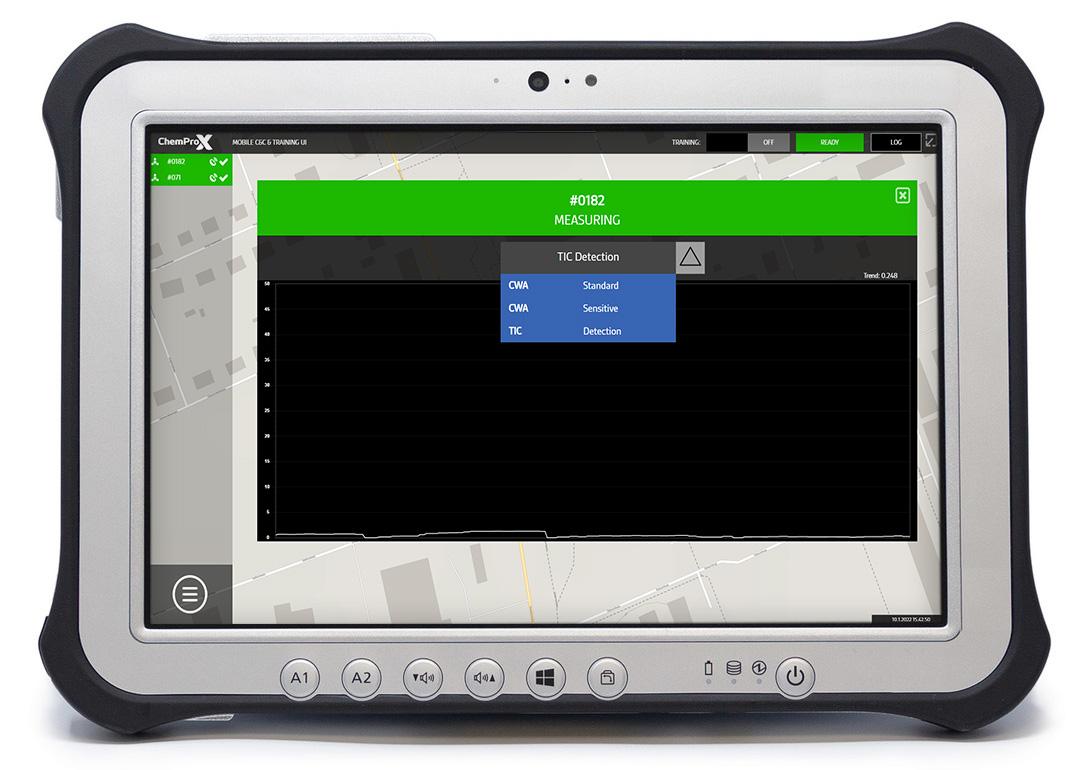
ChemProX in-built Mobile C&C and Training Software features have been optimized to better support unmanned usage in UAV & UGV applications, for instance when the chemical detector is mounted onto a drone or a robot, during reconnaissance and surveying missions.

The latest version of Mobile C&C and Training Software released in January 2022 allows the operator for remotely adjust the detector’s settings according to the ever-changing field requirements.

This Software version enhances ChemProX capabilities of situational overview, when the environment conditions are too dangerous for human exposure. Utilizing the unique trend line display, the operator can remotely monitor even small changes in the atmosphere, and “see” hazardous chemicals before alarm triggering levels.

The latest Mobile C&C and Training Software enables the operator to both change detection mode and check the trend line evolution remotely.

Since the launch of ChemProX new generation handheld chemical detector, frequent software updates have been released. ChemProX users can easily verify if their device’s software version is updated, by simply accessing ChemProX Update Station online, and inserting the serial number plus a security code. Updates can be installed via ChemProX’s Interface Program or utilizing a USB data storage containing the downloaded update file.

Detection

Milrem Robotics delivered the THeMIS Combat UGV to Thailand

At the end of last year, the European leading robotics and autonomous systems developer Milrem Robotics delivered the THeMIS Combat unmanned ground vehicle (UGV) to the Defence Technology Institute (DTI).  The Robotic Combat Vehicle (RCV), as it is known, will be tested and evaluated by the Royal Thai Army and DTI in the near future.

The RCV comprises of the THeMIS UGV and the R400S – Mk2-HD Remote Weapon Station (RWS) by the Australian Space and Defence company Electro Optic Systems (EOS). The RWS also includes the Northrop Grumman M230 LF cannon.  Milrem Robotics is also the system integrator for the RCV.

"It’s our honour to be the robotic systems partner with Royal Thai Army and DTI. This is a significant delivery and deployment for the Milrem THeMIS. It demonstrates that the THeMIS can master very challenging environments. Also, the successful integration of a 30 mm weapon system brings THeMIS’ firepower to the next level. Cooperation with DTI will grow the local robotic technology capabilities in Thailand in terms of the local assembly and system integration,” said Kuldar Väärsi, CEO of Milrem Robotics.

The THeMIS Combat UGVs provide direct fire support for manoeuvre forces and act as a force multiplier. With an integrated self-stabilizing remote-controlled weapon system, they provide high precision over wide areas, day and night, increasing stand-off distance, force protection and survivability. THeMIS Combat UGVs can be equipped with light or heavy machine guns, 40 mm grenade launchers and Anti-Tank Missile Systems.

The THeMIS UGV has already been acquired by 12 countries, including several NATO members. In addition to providing the unmanned vehicle, Milrem Robotics, in cooperation with end-users, is engaged in several systems integration projects.

Milrem Robotics is the leading European robotics and autonomous systems developer and systems integrator. The company is known for its THeMIS and Multiscope Unmanned Ground Vehicles and the Type-X Robotic Combat Vehicle. The THeMIS supports dismounted troops while the Multiscope is intended for civilian use such as forestry and firefighting.  The Type-X Robotic Combat Vehicle is a wingman for mechanized units.

Milrem Robotics is the leader of a consortium that was awarded 30.6M (EUR) from the European Commission’s European Defence Industrial Development Programme (EDIDP) to develop a European standardized unmanned ground system (UGS).

During the project, titled iMUGS, modular and scalable architecture for hybrid manned-unmanned systems will be developed to standardize a European wide ecosystem.

Please find an image of the THeMIS Combat here.

UGV

REAC/TS Just-in-Time Training Video Series

The Oak Ridge Institute for Sicen and Education (ORISE) has a series of free training videos around care of individuals follwing a radiological incident.

The REAC/TS just-in-time are intended for emergency medical responders and providers who need rapid information when called to care for individuals who are ill or injured during a radiological incident. This series is divided into multiple videos by subject matter, each 2-3 minutes in length. You can also watch the entire series in approximately 20 minutes, providing valuable information in a short timeframe. The first releases, addressing Dicentric Chromosome Assay and Personal Protective Equipment (PPE), Patient Decontamination, and Radiological Triage, an be found by clicking th link below. Watch for further additions to this series in early 2022.

https://orise.orau.gov/resources/reacts/just-in-time-training-videos.html

Radiological, Training

Dstl – Apprenticeships that help keep the UK safe

Join DSTL's LIVE event to learn all about Dstl. From their purpose to the size of organisation, values and interesting facts!

You’ll also get to find out about the apprenticeships DSTL offer, the eligibility criteria, the recruitment process, the perks of working for Dstl and the type of people they look for. 

There will also be an opportunity to hear first hand from our apprentices for further insights, followed by a live Q&A session for you to get answers from the experts!

Key Takeaways:

  • Get a top-level understanding of the organisation
  • An understanding of the apprenticeship offering
  • Insights into the recruitment process and how to best-perform throughout process
  • An insight into life as an apprentice at Dstl 

We look forward to seeing you there!

Details

Date:February 11Time:

5:00 pm - 6:00 pm GMT

SIGN UP

Teledyne FLIR identiFINDER R425 and R700 webinars

Teledyne FLIR is pleased to announce the upcoming free virtual webinars, to cover the identiFINDER R425 and the recently released highly sensitive, spectroscopic backpack, the identiFINDER R700.  

These webinars will include a mix of videos, demonstrations, presentation, with an open questions and answers session at the end.  The webinars are expected to last approximately 1 hour 30 minutes.  

Topics will include:

  • Proven Technology which saves lives.
  • identiFINDER R425 and R700 overview.
  • A review of the new Teledyne FLIR RadRemote App, which gives users the ability to control the R425 from the app, allowing use down range.
  • Demonstration of the improved Mass Storage mode and web interface.
  • A review of the new Teledyne FLIR R700 App, which gives users the ability to control the R700 from the app, allowing use down range.
  • Video of Radiological Exposure Device (RED) scenario with high activity shielded source. This demonstrates sensitivity, ID performance, and the user interface which 1000's of users are familiar with.
  • Video demonstrating outstanding sensitivity and ID performance with the R700.
  • identiFINDER R-Series comparison.
  • Field checks to help reduce the Cost of Ownership.
  • Questions and Answers Session.

Available dates:

15th February 2022 at 9:30AM EST        Click Here to Register

17th February 2022 at 11:00AM EST      Click Here to Register

Detection, Webinar

DHS S&T Seeks Mobile Radiation Detection Systems for Emergency Responders

The Department of Homeland Security (DHS) Science and Technology Directorate (S&T) released a request for information (RFI) seeking commercially available mobile radiation detection systems to aid emergency responders on a broad spectrum of radiation detection missions. The technologies will be considered for inclusion in a market survey being conducted by S&T’s National Urban Security Technology Laboratory (NUSTL). The lab is specifically seeking information on radiation detection systems designed to take geo-referenced radiation measurements while carried on or within vehicles such as automobiles, boats, or aircraft. Interested manufacturers have until 5:00 PM EST, February 28, 2022, to submit their products.

“These systems are a key component of emergency preparedness,” NUSTL engineer Cecilia Murtagh explained. “They are used by law enforcement and incident response personnel to find lost, stolen, illegal, or potentially threatening radiological sources, and may be used in hazard assessments in emergency response missions.”

The detection systems use large, sensitive gamma-ray detectors to survey a wide area, integrating radiation and spatial information. On land-based vehicles, they can search along a particular route or park temporarily to monitor passing vehicles and people on foot. Detectors on maritime vessels can monitor radiation from boat traffic at harbors or detect radiation from material dispersed by fires or explosions. On helicopters or airplanes, they can cover large geographical regions to take measurements over potentially hazardous areas or to detect radiation from radioactive material released into the air.

The RFI requires a system to include a large volume gamma-ray detector sensitive to photon energies from 50 keV to 2.7 MeV, can detect small changes in radiation level above the background and can alert the user to changes in the radiation field corresponding to alarm thresholds.

The market survey report is being developed under NUSTL’s System Assessment and Validation for Emergency Responders (SAVER) program. SAVER provides information on commercially available equipment that federal, state, local, tribal and territorial response agencies use in making selection and procurement decisions. The mobile radiation detection systems market survey report will be posted to the SAVER Document Library on the S&T website.

For more information on the RFI, visit Sam.gov.

For more information on the SAVER program, visit www.dhs.gov/science-and-technology/saver.

Detection, Radiation

DHS S&T Seeks Innovative Tech to Defend Against Chemical and Biological Threats

 The Department of Homeland Security (DHS) Science and Technology Directorate (S&T) released a Request for Information (RFI) encouraging chemical and biological defense companies to bring their innovative technologies for test and evaluation in the Chemical and Biological Advanced Capability Testbed (CBT) in the New York City subway system. The deadline for submitting applications to the RFI is 5:00 p.m. EST on February 24, 2022.

“One of our core missions at DHS S&T is to prevent terrorism and enhance security,” said Dr. Don Bansleben, S&T CBT program manager. “A crucial goal is to rapidly identify and respond to an event involving chemical and biological weapons and minimize the impact to the public and critical infrastructure. We’ve established this testbed so that technology developers can test and evaluate their technologies in real-world settings and urban transportation environments.” 

Qualifying applicants will be invited to participate in the Chemical and Bio-defense Testbed in the NYC subway system, which tests and evaluates cost-effective technologies to detect chemical and biological threats inside an actual subway environment, as well as mitigation strategies if threats are discovered. All applicants will be notified no later than March 9, 2022, if they’ve been chosen to participate.

The project team will start integrating the selected technology this spring. This project is a collaboration between S&T, the Massachusetts Institute of Technology (MIT) Lincoln Laboratory, Sandia National Laboratories and Argonne National Laboratory. For more information, visit the SAM.gov and https://cbt.ll.mit.edu/ or contact: .

DHS S&T Seeks Innovative Tech to Defend Against Chemical and Biological Threats.

Drones and pesticide

GDG Environment and SPH Engineering had a nice press release and video of the work that they have been doing on keeping mosquito larvae down, by optimising spraying patterns. GDG Environment provide the different drone and payload models, while SPH provide the software and telemetry. By attacking the larvae at the right time it means that the chemicals involved can be less harsh on the environment and more effective. Some of this research was funded by Health Canada and it is good to see optimised solutions against vectors that carry some of the biggest threats to mankind in the poorest countries. 

It is not hard to see, however, that as these kinds of applications increase, and improve, the chance of them being used for nefarious reasons increases. Real world experiments allow improved modelling and software for downwind dispersal of pesiticides, and this will inevitably have implications for all kinds of releases, from obscurants through to riot control and even CWA. Current offensive drone operations, utilising 40mm grenade drops, require either a large amount of luck or user skill, the misuse of this kind of capability is going to move offensive CBR drone operations from 'too difficult' to 'achievable.' 

To be clear, this is not a slight or either GDG or SPH, the work that they are doing is vital and will save lives and help the environment. They are also not alone in creating these kinds of solutions, and CBRN responders are going to need to bring scenarios where such solutions are used for ill-effect into their training regime as a real risk, rather than a 'speculative' one.  

Our Current Partners